
Wassermarrer (see the “Slang word of the day”)
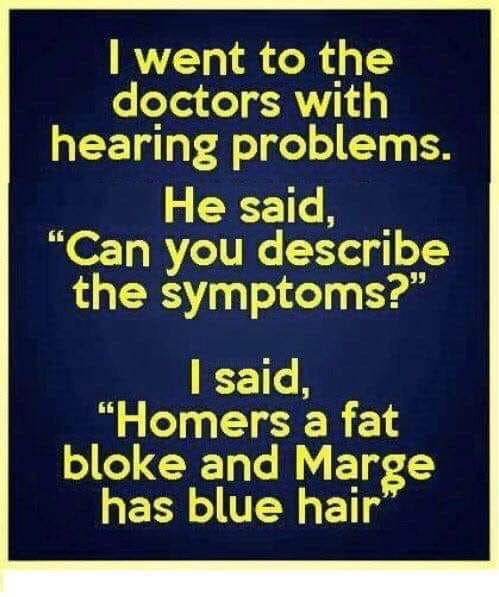
Wassermarrer is an English lazy slang word for “What’s the matter?“
(If you don’t immediately get this “Symptoms” could sound like the Simpsons). A bloke is a man.
English – English – English – English – English – English – English – English – English
Business English Word of the Week:
GeschäftsenglischWort der Woche:
Translate these English words into German.
Acquisition
Efficacious
To recollect
To be frugal
To retort
A Herculean task
Approbation
To Superintend
To be Eloquent
(something is) Inestimable
****************************************************************
Translate the Text into English: Übersetzen:
Faten, Rico, Heike, Simone and Frank.
Translate the English word for “my” etc. (“Mein” etc.)
My
You
His
Her
Our
You all’s
Their
Sind das unsere Orangen?
Unsere Hüte.
Meine Frau und meine Kinder.
Es ist nicht deine Jacke.
Dein Mann schläft.
Ihre Frau ist groß.
Unsere Katzen lesen Zeitungen.
Ihre Frau schreibt.
Deine Jungen lesen eine Zeitung.
Unsere Katze.
Meine Bücher sind schwer.
Ihre Hose ist lang.
Meine Kleider.
Deine (eure / ihre) Blumen!
Ihr Rock ist kurz.
Mag ihre Katze Milch?
Deine Hose ist weit.
Eure Männer sind stark.
Dein Kind hat Hunger.
Mein Hemd ist weit.
**************************************************************
Word of the day: Wort des Tages:
Inebriates (to inebriate, to be inebriated) means to be drunk or intoxicated.
Sample sentence:
“I got somewhat inebriated”. meaning “I got a little drunk.”
Phrase of the day: Satz des Tages:
“There’s no use in crying over spilt milk” = means the phrase ‘Don’t Cry over Spilt Milk‘ means there’s no use in worrying over past events which cannot be changed.
Example of Use:
“I know you didn’t mean to break my phone, so there’s no use in crying over spilt milk now.”
Idiom of the day: Redewendung des Tages:
“Strike whilst the iron is hot!” means make use of an opportunity immediately. This old proverb clearly alludes to the imagery of the blacksmith or farrier at his forge. If he delays in shaping the iron when it is hot and pliable, the metal soon cools and hardens, and the opportunity is lost. (German = Schmiede das Eisen solange es heiß ist.)
This could also be used during battles of say over 100 years ago. When a person was wounded with an old-fashioned bullet, perhaps even a spherical bullet and they were bleeding quite a lot, then they would have some “irons in the fire“ (which is another idiom = Eisen im Feuer haben) and in order to stop the bleeding they used to get a hot iron and apply it to the wound burning the skin and thus closing up the wound.
British (B.E.) / American (A.E.) Vocabulary:
Britisches Englisch / Amerikanisches Englisch Wortschatz:
The “Check” (A.E.) (in a restaurant) the “Bill” (B.E.) please? “The bill please” = “Die Rechnung bitte“. The confusion comes because we have two words that are pronounced the same, but have two different meanings = Cheque and check. “Cheque” = the old fashioned method of payment and to Check on something, (kontrollieren / überprüfen in German).
Pronunciation tip: Aussprachetipp:
“Superficial“ is pronounced SUPER FISH AL, but “Superfluous” (meaning extra, extreme, lavish, unnecessary, or excessive ) is not pronounced SUPER …. it is pronounced SUE PER FLEW OUS.
Wit, wit, wit
Witz, Witz, Witz
“I sometimes feel as if I have nothing to say and I want to communicate this.”
Quote by Damien Hirst.
Slang word of the day: Slangwort des Tages:
Wassermarrer = What’s the matter?
Colloquial / Colloquialisms: Umgangssprache / Umgangssprache:
“To kick the bucket” means to die. Other similar sayings are “to get the big E“, and “to get the elbow“.
Sample sentence:
“When the old girl finally kicked the bucket there was no mention of yours truly in her Last Will and Testament.“
German: “den Löffel abgeben.” / “in die Kiste springen.”
Cockney rhyming slang: Cockney Reimender Slang:
Candlewick, as in: “That’s getting on my wick!“
This means this / that person is annoying me.
Quote of the week: Zitat der Woche:
“To be offended is a choice we make; it is not a condition inflicted or imposed upon us by someone or something else.”
David Bednar.
Recent Comments