
The Importance of being Jack
Note: This is my title based on the book – film below.
My title for this blog originates from a famous book/screenplay/film with the title:
“The Importance of Being Ernest.”
Jack Worthing, the play’s protagonist, is a pillar of the community in Hertfordshire, where he is guardian to Cecily Cardew the pretty, eighteen-year-old granddaughter of the late Thomas Cardew, who found and adopted Jack when he was a baby. In Hertfordshire, Jack has responsibilities: he is a major landowner and justice of the peace, with tenants, farmers, and a number of servants and other employees all dependent on him. For years, he has also pretended to have an irresponsible black-sheep brother named Ernest who leads a scandalous life in pursuit of pleasure and is always getting into trouble of a sort that requires Jack to rush grimly off to his assistance. In fact, Ernest is merely Jack’s alibi, a phantom that allows him to disappear for days at a time and do as he likes. No one but Jack knows that he himself is Ernest. Ernest is the name Jack goes by in London, which is where he really goes on these occasions—probably to pursue the very sort of behaviour he pretends to disapprove of in his imaginary brother.
The Importance of Being Earnest, A Trivial Comedy for Serious People is a play by Oscar Wilde. First performed on 14 February 1895 at the St James’s Theatre in London, it is a farcical comedy in which the protagonists maintain fictitious personae to escape burdensome social obligations. Working within the social conventions of late Victorian London, the play’s major themes are the triviality with which it treats institutions as serious as marriage and the resulting satire of Victorian ways. Some contemporary reviews praised the play’s humour and the culmination of Wilde’s artistic career, while others were cautious about its lack of social messages. Its high farce and witty dialogue have helped make The Importance of Being Earnest Wilde’s most enduringly popular play.
The Original production, 1895
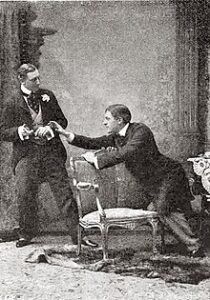
| Written by | Oscar Wilde |
| Date premiered | 1895 |
| Place premiered | St James’s Theatre London, England |
| Original language | English |
| Genre | Comedy, farce |
| Setting | London and an estate in Hertfordshire |
Written by Oscar Wilde. Date Premiered 1895. Place Premiered St James’s Theatre London, England. Original language: English. Genre: Comedy, Farce. Setting: London and an estate in Hertfordshire.
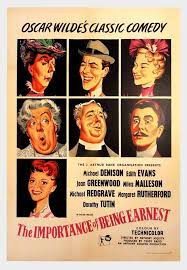
The Importance of Being Earnest is a 1952 British comedy-drama film adaptation of the 1895 play by Oscar Wilde. It was directed by Anthony Asquith, who also adapted the screenplay, and was produced by Anthony Asquith, Teddy Baird, and Earl St. John.
****************************************************************************
Jack is a word and a name that is found in many different things within the English language. Here are a few of them:
Lumberjack 1. One who fells trees and transports the timber to a mill; a logger.
2. A short, warm outer jacket. Also called a lumber jacket.
Jackrabbit: Any of several large, long-eared, long-legged hares of the genus Lepus.
intr. v. jack·rab·bit·ed, jack·rab·bit·ing, jack·rab·bits.
To move or begin to move rapidly or suddenly:
Sample Sentence:
“A rear tyre blew out and the car jackrabbited out of control.” (Sonny Kleinfield).
adj. Moving or beginning to move in a sudden, rapid manner: won the race with a jackrabbit start.
The Union Jack Flag of Great Britain (made up of three flags = English = Saint George, Irish = Saint Patrick and Scottish = Saint Andrew). England was not on friendly terms with Wales when the Union Jack was designed.

Jack and the Bean Stalk (= a children’s Pantomime play). It is amazing how many characters in plays, TV programs and films where the main character is called Jack (the most recent example: “The Pirates of the Caribbean” with Captain Jack Sparrow.)
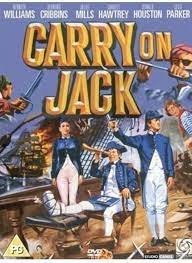
“I’m alright Jack!” Also, a British comedy film (1964) called, “Carry on Jack.”
Jack n.
1. often Jack Informal A man; a fellow.
2. a. One who does odd or heavy jobs; a labourer. (“A Jack of all trades”.)
b. One who works in a specified manual trade. Often used in combination: a lumberjack; and a steeplejack.
c. Jack = A sailor; a Jack tar or even a Jolly Jack Tar.
3. Abbr. J Games: A playing card showing the figure of a servant or soldier and ranking below a queen. Also called knave.



Recent Comments