Barking dogs seldom bite
by Mark Brislin | Mar 18, 2021 | 2021, Allgemein, Britisches Englisch / Amerikanisches Englisch Wortschatz, Falsche Freunde Tipp der Woche, Geschäftsenglisch, Rechtsenglisch, Satz des Tages, Spezieller Grammatik Tipp der Woche, Umgangssprache, Wort des Tages, Wortschatz für Verträge und Verhandlungen |
The English saying “barking dogs seldom bite” is an English proverb that means that people who make a lot of noise and threats are usually not the ones who will actually do anything. It is often used to comfort someone who is being threatened or bullied by someone who is all bark and no bite.

Business English Word of the Week:
Geschäftsenglisch Wort der Woche:
Consider meaning to Reflect, Contemplate, Cogitate, Ruminate, or think something through carefully. (Nachdenken, Überlegen, Abwägen…)
Law English Word of the Week:
Gesetz Englisches Wort der Woche:
Deliberate means to be thoughtful, to be cautious, to have a measured approach. Lawyers, as well as the Jury (die Jury), in a courtroom, are often asked by the Judge (der Richter) to “Deliberate“. They need to think about whether the person is guilty or not guilty (schuldig oder nicht schuldig).
Vocabulary for Contracts:
Wortschatz für Verträge:
to sign a contract = einen Vertrag unterschreiben, a signature = eine Unterschrift,
to initial a contract = einen Vertrag zu initialisieren.
Sample sentence:
The delivery driver to their customer says, “Could you just initial the delivery note, please?“
Vocabulary for Negotiations:
Wortschatz für Verhandlungen:
The special English word to haggle over price means to bargain, to barter, to quibble, to wrangle, to negotiate, to beat down the price.
************************************************************
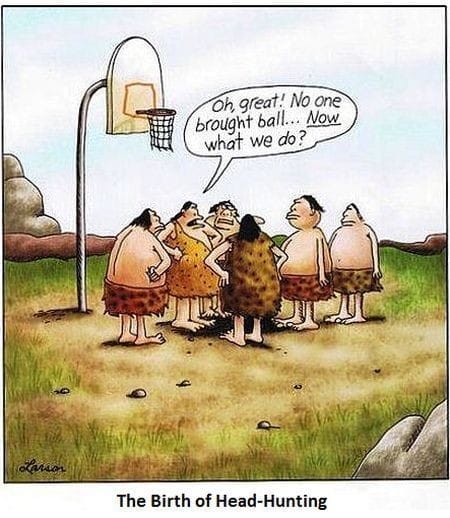
The man second from last to the right of the group
has quite a round-looking head, so I guess he was ‘IT’. Look at the size of his head and the size of the basket.
Word of the day: Wort des Tages:
To ponder means to consider (prüfen, Bedenken), to contemplate (Überlegen), to Deliberate, to Muse, to think over, to wonder about, and to brood over.
Phrase of the day: Satz des Tages:
The English slang word Cheesy (käsig) means too cheesy pick-up lines. A direct translation is ‘kitschige‘ Pick-up-Linien.
Cheesy is used to mean something that is very obviously joking or over-the-top. It can be funny, annoying or even uncomfortable and embarrassing to hear someone say something super cheesy. It can be even worse if someone does something cheesy. Similar words to “cheesy” include “corny” and “tacky.” “Corny” is a synonym (a word that means the same thing) of cheesy. However, “tacky” sounds more negative and generally is used to refer to something that is cheap or in bad taste (Kitsch).
****************************************************************
Translate the Text: Übersetzen:
Susann, Andreas, Nadine, Heike, Reiner, and Simone.
Which witch? welch.
Welches Kleid?
wo, wohin, and woher.
Wo ist sein Schuh?
Woher kommst du?
Wohin gehst du?
Womit schreibt er?
Worüber spricht sie?
Mark kennt alle Antworten.
Welches Kind ist es?
Wem geht es schlecht?
Wohin geht sie?
Wessen Jacke ist es?
Wem schreibst du?
Die Antwort.
*********************************************************
Idiom of the day: Redewendung des Tages:
This is an English idiom that is used quite a lot = “Barking dogs seldom bite“. The possible meaning: Don’t be afraid of dogs that bark or people that threaten you (or when people say they will do something bad to you) – in both cases, they rarely take action.
NOTE: “To call their bluff.” / Lass sie bluffen.
British (B.E.) / American (A.E.) English Vocabulary:
Britisches Englisch / Amerikanisches Englisch Wortschatz:
Mobile phone, Smartphone (B.E.) Cellular phone (A.E.) (Cell phone for short); German ‘Handy’.
The word “Handy” is a real English word and it means ‘useful‘ or ‘easy to hand‘. The German use of this English word is a slang word in German, but it would not be understood in the UK or anywhere else outside of the USA and Canada.
Special Grammar tip of the week:
Spezieller Grammatik-Tipp der Woche:
The use of “A” and “An“. There are 5 vowels (Vokale) in the English language = a, e, i, o, u. For any singular word beginning with one of these 5 vowels, then we use “AN” = a box, a candle, a pen, a watch, a computer, a desk, a mobile phone, a printer, etc. However, there are some exceptions to that rule! This has to do with how the word is pronounced. The following words begin with the letter “H“, but the “H” is NOT pronounced.
hour, hourly, honour, honourable, honest, and honesty, there are a few more examples, but not too many. So we say an hour, an honest man.
Then there are the words that begin with the letter “U” where we do NOT see the letter “U“, but we pronounce it with the letter “Y“. For example:
University, uniform, universal, uniformity, and one or two others. You can see that these words ALL begin with UNI.
So we say, a University and a uniform.
For example: A (Y) European country. A (Y) euro coin.
NOTE: An MBA = An with letters.
Pronunciation tip: Aussprachetipp:
Taught the letters “au” are pronounced “or” K-or-T (same pronunciation as a Tennis Court or a Court of Law).
For example: “I have caught a cold. I caught the ball. I caught a fish.”
NOTE: Sauna is SOR NA.
JOKES / PUNS:
What did the digital clock say to its mother? Look, mum, no hands!
False Friends: Falsche Freunde:
Labour / Labor
Translate the following sentences:
-
The cost of labour is rather high in Germany.
-
Ich arbeite zwei Tage in der Woche im Labor.
1. Die Arbeitskosten sind in Deutschland ziemlich hoch.
2. I work two days a week in the laboratory.
Both the English and the German go back to the Latin verb laborare, meaning “to work“. Laboratorium is a Medieval Latin word meaning “a place for work“, and the short form is the word “Lab“.
Wit, wit, wit
Witz, Witz, Witz
“Varnishing is the only artistic process with which the Royal Academicians are thoroughly familiar.”
Quote by Oscar Wilde.
Slang word of the day:
Slangwort des Tages:
This is a strange English slang word = Whatchamacallit is what a person will say when they cannot think of the word for that thing/object etc., at that very moment. (Das Dingsbums).
Sample sentence:
“Pass me that Whatchamacallit, will you?“
Cockney rhyming slang:
Cockney Reimender Slang:
Many of us know that “brown bread” is Cockney rhyming slang for dead, “china plate” for ‘mate‘, meaning a friend (often a Londoner would say, “Me Ole China“), and “bubble bath” meaning to “laugh”. But how many know the meaning of the phrases? The historic native wit of this east-end community (and its followers from around the world) often has an interesting logic to its phrases. Rather than simply a rhyming association, the slang reflects meaning in the expressions themselves. Here’s a guide to the most commonly used Cockney rhyming slang:
Sample sentence:
“What a load of pony an’ trap.” Have a guess what this means?
Was für ein Haufen “Scheiße“.
E.G. To have ‘a Pony‘.
Quote of the week: Zitat der Woche:
“Thankfulness can take you places where complaining will only leave you stuck!”
Quote by Mark Brislin.

Fortgeschrittene, Anfänger, Geschäftsenglisch, Firmenkurse, Gruppenunterricht, Inhouse-Englisch, Sprachschule Englisch, Telefonkonferenz Englisch persönlich oder per Videokonferenz; in Dresden, Chemnitz, Freiberg, Brand-Erbisdorf, Halsbrücke, Lichtenberg, Meißen, Döbeln, Riesa und überall in Sachsen seit über 20 Jahren!
Delivering professional Business English teaching in person or via video conferencing in Dresden, Chemnitz, Meißen, Brand-Erbisdorf, Lichtenberg, Freiberg, Döbeln, Riesa, Halsbrücke, and all over the state of Sachsen for over 20 years!

Recent Comments