
Sweet Fanny Adams
Fanny Adams/ˌfanɪ ˈadəmz/
noun informal•British English, plural noun: sweet Fanny Adams; noun: sweet Fanny Adams, which means ‘nothing at all‘.
NOTE: Sometimes, in films, you hear the actor say, “Sweet F.A.“, probably because the F.A. does not mean Fanny Adams, but rather “F_ck All.”
“I know sweet Fanny Adams about working in the Aeronautical industry.“
What company do you think this is in the picture below?

English – English – English – English – English – English
**********************************************************************
Translate the Text into English: Übersetzen:
Susann, Reiner, Heike, Simone, Nadine and Andreas.
das Zeug
das Feuer
das Fahrzeug
das Feuerzeug
der Flug
das Flugzeug
das Spiel
das Spielzeug
das Werkzeug
Ich mag keine Feuerzeuge.
Mein Feuerzeug ist neu.
Die Frauen mögen die Werkzeuge.
Das ist mein Spielzeug.
Ist das mein Fahrzeug?
Ich habe kein Feuerzeug.
Sein Fahrzeug ist alt.
Wir haben kein Fahrzeug.
Das Spielzeug.
Ich bin nicht dein Spielzeug.
Das Kind hat ein Spielzeug.
Ich habe kein Flugzeug.
Hast du ein Feuerzeug?
Ist das dein Zeug?
Das ist nicht mein Zeug.
Mein Werkzeug, bitte!
English – English – English – English – English – English – English – English
********************************************************
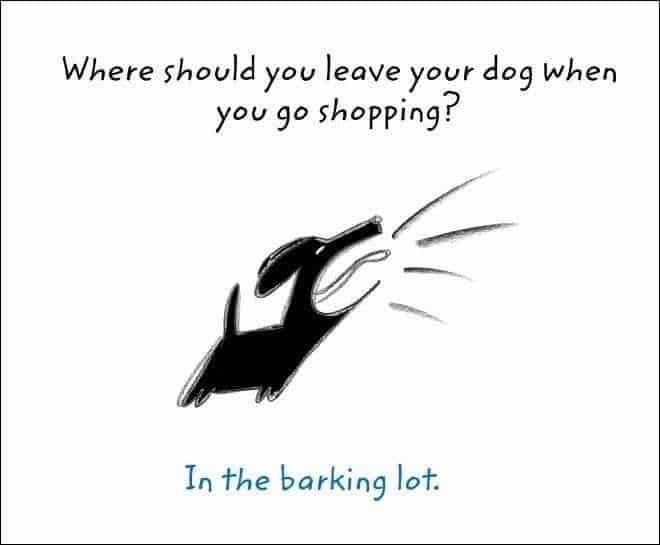
NOTE: The funny cartoon above is American, because Americans say ‘Parking Lot and the British say ‘ car park‘.
Word of the day: Wort des Tages:
‘Edible‘/’eatable‘ mushrooms (German ‘Essbar‘).
Sample Sentence
“Are those edible mushrooms?“
Phrase of the day: Satz des Tages:
Sweet Fanny Adams
-
nothing at all.
“I know sweet Fanny Adams about mining.”
-
A nautical (meaning being at sea in the ocean) term for tinned meat or stew.
We also say, “Sweet F. A.” for short. Some people use other words for the meaning of F and A.
Idiom of the day: Redewendung des Tages:
“Call it a day” means to stop working on something. Sometimes lovers may say this to mean let’s stop our relationship.
British (B.E.) / American (A.E.) Vocabulary:
Britisches Englisch / Amerikanisches Englisch Wortschatz:
B.E. a.s.a.p. The British say the letters one after the other = which means as soon as possible.
A.E. = Americans say this as the word “asap”, = which means as soon as possible.
Special Grammar tip of the week:
Spezieller Grammatik-Tipp der Woche:
Pay attention to homophones
Homophonic words are words that are pronounced in the same way as other words, but have different meanings, even if they are spelt differently. This can obviously (offensichtlich, offenbar) create confusion and unfortunately, there are many of these words in English. For example:
-
they’re – their – there
-
you’re – your
-
it’s – its
-
I – eye
-
here – hear
-
break – brake
-
flower – flour
-
our – hour
-
ate – eight
-
Bear – bare
-
Four – for
-
To – too – two
-
So, sew sow (Die Sau).
So when you’re writing, be careful to choose the right spelling. And when you listen, remember that a word you think you understood may have another meaning. Try to understand the meaning from the context.
Pronunciation tip: Aussprachetipp:
Speak Slowly and Exaggerate (Übertreiben) the Sounds
Many English students think that the faster they speak, the better an impression they will make. This isn’t usually the case. Speaking fast tends to slur (lallen) their speech (ihre Rede undeutlich machen) and reinforce bad habits. Speaking slowly, on the other hand, will give you time to think about what you are saying and how you are saying it. It will also make you feel more relaxed.
Also, as you practice your speech, it’s always a good idea to exaggerate (Übertreiben) your sounds at the beginning. Pay special attention to the ones you have trouble pronouncing. This may seem a little strange to you at first, but don’t worry. It’s an excellent exercise for improving your pronunciation.
JOKES / PUNS:
As I handed my dad his 50th birthday card, he looked at me with tears in his eyes and said:
“You know… one would’ve been enough.”
False Friends Tip of the Week:
Falsche Freunde Tipp der Woche:
Sensible – Vernünftig / reif (ripe)
Sensitive – Empfindlich.
As these words are also used in German, this is why they seem to have a mix-up in understanding. If I say that he is a
Sensible boy, Germans often understand that I mean that he is a ‘Sensitive boy‘. The former meaning:
Sensible = Reasonable – Rational
Sensible = cognizant – conscious
Sensible = perceptible – discernible
whereas the latter is a ‘Sensitive boy‘ meaning:
Sensitive – tender – delicate
Sensitive – painful – sore
Sensitive – soulful – sympathetic
Slang word of the day:
Slangwort des Tages:
Proper (adj)
Proper is a difficult word to define, mainly because British people use it to describe so many different things. Doing things ‘properly’ means doing them correctly or in the right way. In the North of England, ‘proper’ can also be used for emphasis in the same way as the word ‘very‘.
Sample Sentence
“A proper cup of tea needs milk and one spoonful of sugar.” “That’s the way to make a proper good cup of tea.”

Wit, Wit, Wit Business examples:
Witz, Witz, Witz Geschäftsbeispiele:
“A cigarette is a perfect type of a perfect pleasure. It is exquisite, and leaves one unsatisfied. What more can one want?”
Quote by Oscar Wilde.
Colloquial / Colloquialisms:
Umgangssprache / Umgangssprache:
Knackered (adjective)
Simply put, knackered means really, really tired (“Dog Tired” as we had in another Blog of mine). The term is used to describe the person who cleared dead animals away in the slaughterhouse, but is now used to say you’re exhausted (erschöpft). Just be a bit careful when using this one, some people consider this word to be impolite and so it is not to be used in ‘Polite company’.
Sample Sentence
“I can’t come to the pub, mate, sorry and all that; but I’m feeling absolutely knackered.”
Cockney rhyming slang:
Cockney Reimender Slang:
“Cream Crackered” = “Knackered” is the Cockney Rhyming Slang for the Colloquial word above. Some people will say, “I’m creamed!” as a short form of the same thing.
Quote of the week: Zitat der Woche:
Donkey and the Tiger argument:
The donkey told the tiger, “The grass is blue.“
The tiger replied, “No, the grass is green.”
The discussion became heated, and the two decided to submit the issue to arbitration, so they approached the lion.
As they approached the lion on his throne, the donkey started screaming: ′′Your Highness, isn’t it true that the grass is blue?“
The lion replied: “If you believe it is true, the grass is blue.“
The donkey rushed forward and continued: ′′The tiger disagrees with me, contradicts me and annoys me. Please punish him.“
The king then declared: ′′The tiger will be punished with 3 days of silence.“
The donkey jumped with joy and went on his way, content and repeating, ′′The grass is blue, the grass is blue…“
The tiger asked the lion, “Your Majesty, why have you punished me? After all, the grass is green.“
The lion replied, ′′You’ve known and seen the grass is green.“
The tiger asked, ′′So why do you punish me?“
The lion replied, “That has nothing to do with the question of whether the grass is blue or green. The punishment is because it is degrading for a brave, intelligent creature like you to waste time arguing with an ass, and on top of that, you came and bothered me with that question just to validate something you already knew was true!“
The biggest waste of time is arguing with the fool and fanatic who doesn’t care about truth or reality, but only the victory of his beliefs and illusions. Never waste time on discussions that make no sense. There are people who, for all the evidence presented to them, do not have the ability to understand. Others who are blinded by ego, hatred and resentment, and the only thing that they want is to be right even if they aren’t.
When IGNORANCE SCREAMS, intelligence moves on.
A Great British beer – Old Speckled Hen! When I was celebrating my Silver Wedding on the island of Cyprus, I found many British products were on sale in the local supermarkets.

Recent Comments