An army marches on its stomach.
by Mark Brislin | May 6, 2026 | 2026, Allgemein, Britisches Englisch / Amerikanisches Englisch Wortschatz, Falsche Freunde Tipp der Woche, Geschäftsenglisch, Rechtsenglisch, Satz des Tages, Spezieller Grammatik Tipp der Woche, Umgangssprache, Wort des Tages, Wortschatz für Verträge und Verhandlungen
Someone threw a jar of mayo at me. I was like, what the Hellman?!
NOTE: Business English etc.
can be found below the translation exercises.
Translate the Text into English: Übersetzen:
Susann, Andreas, Nadine, Heike, Reiner, and Simone.
Animals:
Eating like…!
Essen and fressen both mean to eat, but they’re not the same!
Fressen is for animals, so using fressen with a person shows you think they eat like an animal.
Der Hund frisst Brot.
The dog eats bread.
Der Mann isst Brot.
The man eats bread.
Der Mann frisst Brot.
The man eats bread (like an animal).
Frankenwords
der Saft
die Orange
der Orangensaft
das Tier
das Haus
das Haustier
Pfft
Pferd, Apfel as in “capful”
Vogel, verstehen as in “fun”
Wasser, Wein as in “van”.
*********************************************************
English – English – English – English – English – English – English
Procrastinators Anonymous meeting postponed indefinitely.
Business English Word of the Week:
Geschäftsenglisch Wort der Woche:
A business word/phrase = A spike in the number of sales.
A spike in the number of sales refers to a sudden, sharp, and usually temporary increase in the volume of products or services sold over a short period, rather than a slow, steady growth. While typically viewed as positive, a “spike” often implies a deviation from the norm, which can represent a temporary opportunity or, in some cases, a potential supply chain issue.
Law English Word of the Week:
Gesetz Englisches Wort der Woche:
A law word/phrase = To “Claim compensation” means formally requesting money or benefits to cover losses, injuries, or damages caused by another party’s negligence or a breach of contract. It aims to restore the victim to their pre-damage financial position, often covering medical expenses, lost wages, and property damage
Sample Sentence:
“A claim for compensation must always be in a written form, together with photographic evidence and witness testimonies.”
Vocabulary for Contracts:
Wortschatz für Verträge:
A word/phrase for contracts = Merchant ships – Handelsschiffe. ‘The Merchant Navy’ = a collection of ships to transport goods and is NOT a Military organisation. A merchant ship is a commercial vessel used to transport cargo or passengers for hire, distinguishable from naval (military) or pleasure craft. These ships are vital for global trade, transporting raw materials and goods, and include tankers, container ships, and cruise liners. Synonyms include merchantman, merchant vessel, freighter, and trading vessel.
Vocabulary for Negotiations:
Wortschatz für Verhandlungen:
A word/phrase for negotiations = when negotiating. An emergency fund in a contract context generally refers to a dedicated, readily accessible pool of cash reserves set aside by an organisation, business, or individual to cover unexpected expenses, revenue disruptions, or urgent operational needs. Key Aspects in Contracts:
-
Definition & Purpose: It is a “cushion” fund created to ensure stability during unforeseen financial crises, such as sudden job loss, major home repairs, or business disruptions.
-
Emergency Funding Clause: Such clauses establish conditions for accessing additional resources in urgent situations. These typically outline the process for requesting funds, criteria for approval, and limitations on the amount or usage.
-
Operational Use: The fund allows businesses to continue operations, pay staff, or cover supplier costs if income suddenly drops.
-
Liquidity Requirement: Emergency funds should be held in highly liquid, low-risk vehicles (e.g., high-yield savings accounts or money market funds) to ensure immediate access without penalties.
-
“Three to Six Months” Rule: Financial experts often recommend that emergency funds cover 3-6 months of essential living or operating expenses.
-
Separation: It is often advised to keep these funds in a separate account to avoid using them for daily transactions or non-emergency expenses.
English – English – English – English – English – English – English
*****************************************************
Improve your memory. Do unforgettable things.
Word of the day: Wort des Tages:
a Foundling – ein Findelkind.
Phrase of the day: Satz des Tages:
“By the sweat of your brow” means earning a living through intense physical labour, hard work, or significant effort. Originating from Genesis 3:19, it symbolises earning sustenance through toil rather than ease. It is frequently used to emphasise that success or money was gained through personal struggle and diligence.
Sample Sentences:
Usage Examples:
-
“She established his entire company by the sweat of her brow.”
-
“He earned his post-Graduate degree by the sweat of her brow.”
-
“The early cavemen grew their own food by the sweat of their brow.”
-
“He earned his wages by the sweat of his brow.”
Idiom of the day: Redewendung des Tages:
“Nothing ventured, nothing gained,” means you must take risks or try new things to achieve success or positive results. It encourages taking action, as doing nothing ensures no progress is made. The idiom highlights that without risking failure or effort, one cannot gain rewards.
Key Usage Examples:
-
Business/Career: “He decided to ask for a raise; after all, nothing ventured, nothing gained.”
-
New Experiences: “He was nervous to move to a new city, but he figured nothing ventured, nothing gained.”
-
Learning: “I’m going to try speaking in German, even if I make mistakes. Nothing ventured, nothing gained.”
Synonyms and Similar Idioms:
-
“No pain, no gain.” (Often used to do with sports/health exercises/weight loss)
-
“Nothing try, nothing have.” (I have not heard this one before, perhaps it’s from the USA?)
-
“Risk it for a biscuit.” There was a British advert in the 1970’s with the slogan, “I’ll risk it for a Swisskit,” for a chocolate-covered muesli bar, often misremembered today as “risk it for a biscuit.”
-
“Fortune favours the bold” is an idiom meaning that taking risks, being courageous, and acting decisively increases the likelihood of success and rewards, rather than waiting passively. It is an ancient proverb encouraging proactive, brave action over hesitant caution, suggesting that success rarely comes without risk.
British English / American English Vocabulary:
Britisches Englisch / Amerikanisches Englisch Wortschatz:
British English (B.E.) = a pneumatic drill
American English (A.E.) = ‘A jack hammer’
A jackhammer is primarily called a pneumatic drill or a breaker (or concrete breaker) in British English. While “jackhammer” is understood, these terms are more commonly used in the UK construction for the handheld, compressed-air-powered tool designed to break up concrete, pavement, or rock.
-
Pneumatic Drill: Often used for the traditional air-powered version.
-
Breaker / Demolition Breaker: Frequently used by construction professionals for both electric and pneumatic handheld breakers.
-
Road Drill: Another term used for the large tools used on roads.
Special Grammar Tip of the Week:
Spezieller Grammatik-Tipp der Woche:
Any product or thing is MADE FROM wood, plastic, metal, leather and glass, etc. Also, something is MADE OF e.g. wood, glass, etc.
Pronunciation Tip: Aussprachetipp:
Blow – blown / Sow – sown / Show – shown / Spoke – Spoken / Woke – woken / Broke – broken.– notice that when a word has either a ‘W’ or an ‘E’ at the end of the word, then the PAST PARTICIPLE (Partizip Perfekt), you just add an ‘N’.
False Friends Tip of the Week:
Falsche Freunde Tipp der Woche:
German = Depp, Schwachkopf
Translation = Idiot, moron, a schmuck
False Friend (F.F.) = Schmuck
Meaning of F.F. = Jewellery
******************************************************
English – English – English – English – English – English – English
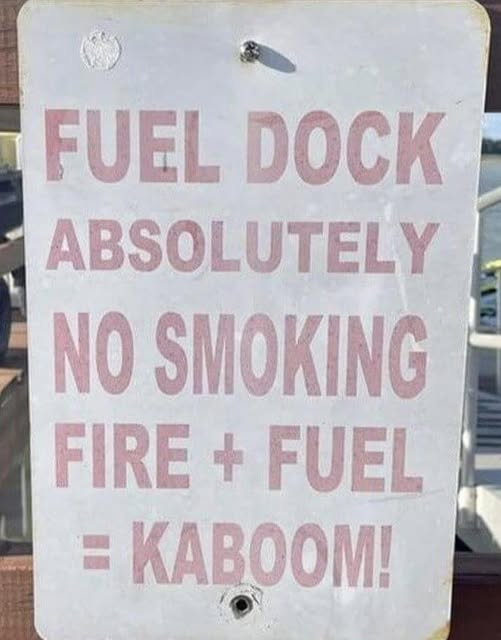
Wit, wit, wit – Food:
Witz, Witz, Witz – Ausbildung:
“The proof that God has a really weird sense of humour is that, having invented the sublime mystery of haute cuisine, he went and give it to the French.”
Quote by A. A. Gill.
NOTE: This should read GAVE, to be grammatically correct, but I think A. A. Gill is from America?
******************************************************
English – English – English – English – English – English – English

Slang word of the day:
Slangwort des Tages:
“We need to nip it in the bud” means to stop a potential problem or negative behaviour immediately at an early stage, before it escalates or becomes unmanageable. Derived from gardening, this idiom suggests killing a problem while it is still just a “bud,” preventing it from growing into a much larger issue.
Key Aspects & Usage Examples:
-
Preventing Bad Habits: “We’ve noticed that Jon’s getting in the bad habit of speaking with his mouth full of food. We’d better nip that in the bud.”
-
Stopping Conflict: “A Head teacher mediating an argument immediately to stop a conflict from escalating is an example of nipping something in the bud.”
-
Handling Financial Problems: “We have to nip these cash flow problems in the bud before the company gets into some real trouble.”
-
Business/Urgent Actions: “Hyperinflation will only start if our government doesn’t do something right away to nip it in the bud.”
Colloquial / Colloquialisms:
Umgangssprache / Umgangssprache:
“Bricklayer’s cleavage” (also known as plumber’s crack or Maurerdekolleté in German) is a colloquial term for the visible top of a person’s buttocks and cleft, typically exposed when their pants slip down while bending over. It is often used humorously to describe this common, accidental exposure.
Cockney Rhyming Slang:
Cockney Reimender Slang:
Dukes = Duke[s] of York = fork, i.e. hand, now chiefly when balled into a fist.
Quote of the week: Zitat der Woche:
“When you have more than you need, it stops being just yours. It becomes your responsibility to help those who are still struggling at the bottom.”
Quote by Alice Cooper.
*********************************************************
English – English – English – English – English – English – English
Fortgeschrittene, Anfänger, Geschäftsenglisch, Firmenkurse, Gruppenunterricht, In-house Englisch, Sprachschule Englisch, Telefonkonferenz Englisch persönlich oder per Videokonferenz; in Dresden, Chemnitz, Freiberg, Halsbrücke, Lichtenberg, Brand-Erbisdorf, Meißen, Döbeln, Riesa und überall in Sachsen seit über 20 Jahren!
Delivering professional Business English teaching in person or via video conferencing in Dresden, Chemnitz, Meißen, Lichtenberg, Freiberg, Döbeln, Riesa, Halsbrücke, Brand-Erbisdorf and all over the state of Sachsen for over 20 years!

Recent Comments